digital menu boards for restaurants
Restaurant menus change constantly. Prices are updated, products sell out, daily specials come and go, and the right promotion at lunchtime may make little sense in the evening.
On this page
Restaurant menus change constantly. Prices are updated, products sell out, daily specials come and go, and the right promotion at lunchtime may make little sense in the evening.
Printed menu boards make every change slower. Even a small price adjustment can require new printing, replacement signs, or temporary stickers that make the menu look inconsistent.
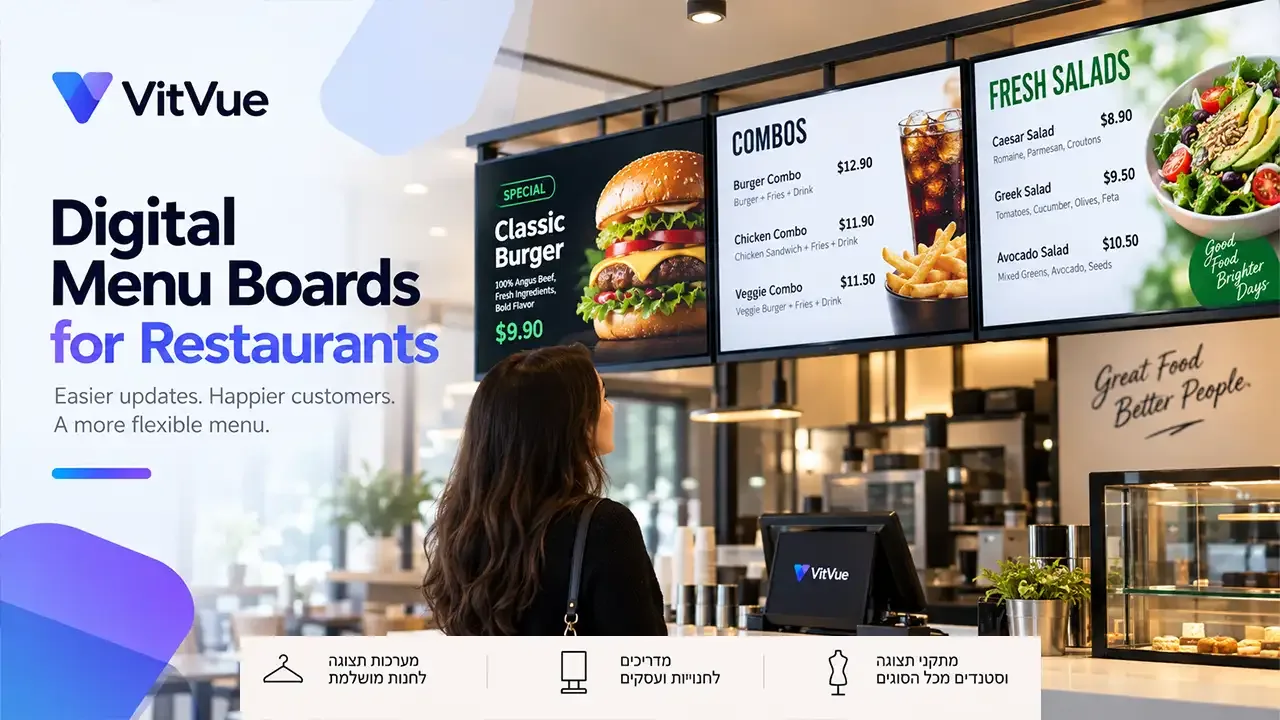
Digital menu boards for restaurants offer a more flexible alternative. Instead of treating the menu as a fixed sign, restaurants can manage what customers see on screen and update that content whenever the business requires it.
For restaurants, cafés, bakeries, fast food locations, and other food businesses, digital menu boards can make menu management simpler while creating a cleaner and more engaging customer experience.
What Are Digital Menu Boards for Restaurants?
Digital menu boards are screens used to display menu items, prices, images, promotions, specials, and other information inside a restaurant.
They are commonly installed above ordering counters, near entrances, in waiting areas, or in other locations where customers make purchasing decisions.
Unlike traditional printed signage, the content on a digital menu board can be changed through software. This means restaurant teams do not need to replace the physical sign every time they want to change a price, remove an unavailable item, or promote something new.
A digital menu board can display a simple static menu, but it can also rotate between different layouts, highlight products, display video, promote limited offers, and automatically show different content throughout the day.
Why Restaurants Are Moving Away From Printed Menu Boards
Printed menus still work, but they become increasingly restrictive when a restaurant needs to make frequent changes.
With digital menu boards for restaurants, menu content can be managed remotely rather than being physically replaced every time something changes.
This is useful when a restaurant needs to update several things during a normal week.
A price may change.
A popular item may temporarily sell out.
A new dish may be introduced.
A promotion may only be available during certain hours.
A seasonal menu may replace the regular menu for a limited period.
With printed signage, each change can create additional work. With digital screens, the menu becomes something the restaurant can actively manage.
Update Menu Prices Without Reprinting Everything
Pricing changes are one of the clearest reasons to use digital menu boards.
Restaurants regularly need to adjust prices due to ingredient costs, supplier changes, promotions, or changes to the menu itself.
With a printed board, even changing the price of one item may require a new sign.
Digital menu boards allow the restaurant to edit the content and publish the updated version to the screen.
This can be especially valuable for restaurant groups with several locations. Instead of sending updated artwork to every branch and relying on employees to replace physical signs correctly, menu changes can be managed from a central system.
The result is a more consistent menu across the business.
Show Different Menus at Different Times of Day
A restaurant does not always need to show the same menu from opening until closing.
A café may serve breakfast in the morning, lunch in the afternoon, and a smaller evening menu later in the day.
A fast food restaurant may want to promote coffee early in the morning and meal combinations during lunch.
Digital signage scheduling makes this easier.
With VitVue, businesses can schedule playlists according to time, day, or location, allowing different content to appear automatically.
Instead of asking an employee to manually replace the breakfast menu at a specific time every day, the restaurant can prepare the content in advance.
This creates a more consistent process and helps ensure customers are seeing relevant information when they are ready to order.
Promote High Value Items More Effectively
A menu board does more than list what is available.
It can also influence what customers notice first.
Restaurants can use prominent areas of the screen to feature signature dishes, meal combinations, desserts, drinks, upgrades, or limited promotions.
Visual hierarchy matters.
If every menu item uses the same size and receives the same amount of attention, customers may struggle to understand what the restaurant wants to emphasize.
Digital screens make it easier to create clear sections and dedicate space to priority products.
For example, a restaurant could display its regular menu on most of the screen while reserving another area for a changing promotion.
That promotion could feature a new dish during one week and a meal combination during the next.
Use Better Visuals Without Making the Menu Difficult to Read
Food photography can make a menu more attractive, but digital menu boards still need to function primarily as menus.
Customers should be able to quickly understand what is available and how much it costs.
This means restaurants should avoid filling every part of the screen with images, animation, and promotional messages.
The strongest layouts usually create a balance between visual appeal and clarity.
Restaurant owners can start with digital signage templates rather than designing every layout from the beginning. VitVue currently includes restaurant templates for concepts such as sushi, pizza, bakeries, steak restaurants, juice businesses, and lunch menus.
A good template provides a starting structure while still allowing the restaurant to customize the menu, branding, images, and prices.
Manage Multiple Restaurant Screens From One Place
A single restaurant may use several menu screens.
One display might show main dishes.
Another might focus on drinks.
A third could promote desserts or special offers.
Businesses with several restaurant locations have an additional challenge because they may need to manage dozens of screens.
Digital signage software makes it possible to organize those screens centrally.
VitVue includes screen groups that allow displays to be organized according to location or purpose.
This means a restaurant group can maintain common branding while still displaying different content in different branches.
A promotion available in one location does not necessarily need to appear everywhere.
Do You Need Special Hardware for Digital Menu Boards?
This is an important question because hardware can significantly increase the cost of a digital signage project.
Some digital signage systems require a dedicated media player connected to every television.
VitVue takes a different approach. According to its current restaurant solution, restaurants can use Android TV, Google TV, supported Smart TVs through a browser, or add a compatible streaming device to another television.
This can make digital menu boards easier to deploy when the restaurant already has suitable screens.
Before selecting any digital signage platform, restaurants should check what devices are supported and calculate the total cost of the setup, not only the software subscription.
What Happens If the Internet Goes Down?
Restaurant screens should not suddenly become empty because the internet connection drops for a few minutes.
Offline playback helps reduce this risk.
VitVue caches supported content locally so downloaded content can continue playing if connectivity is temporarily interrupted. Online sources and live widgets still require an internet connection.
For a restaurant, this is important because the menu is part of the ordering process.
A temporary connection problem should not prevent customers from seeing basic menu information.
Where Can Restaurants Use Digital Menu Boards?
The most obvious location is behind the ordering counter, but restaurant digital signage can be used in several areas.
A screen near the entrance can display promotions before customers order.
A window display can attract people passing outside.
Screens behind the counter can present the main menu.
Additional screens can highlight desserts, drinks, upgrades, or seasonal products.
VitVue also identifies applications such as drive through menu screens, order status displays, promotional displays, and seasonal restaurant content.
The important point is that each screen should have a clear purpose.
Adding more screens does not automatically improve the experience. The content on those screens needs to support the customer journey.
How to Design an Effective Restaurant Menu Board
A good digital menu board should be easy to understand within seconds.
Start by deciding what information customers need first.
Usually, that means clear categories, product names, prices, and any essential options.
Use large enough text so the menu can be read from the expected viewing distance.
Avoid overcrowding the screen with too many products.
Use images selectively.
Keep prices visually connected to the correct items.
Make promotions noticeable without allowing them to overpower the main menu.
The goal is not to make the screen look as busy as possible. The goal is to help customers understand the offer and make a decision.
How Digital Menu Boards Help Restaurant Operations
The benefits of digital menu boards are not limited to design.
They can also simplify everyday restaurant operations.
Instead of coordinating printing every time something changes, employees can update menu information digitally.
Instead of manually changing signs several times per day, scheduled content can handle recurring menu changes.
Instead of maintaining completely separate signage processes for every branch, restaurant groups can manage multiple screens through one platform.
For businesses that change menus frequently, these operational improvements may be just as important as the appearance of the screens.
Choosing Digital Menu Board Software for Your Restaurant
When comparing digital menu board platforms, restaurants should focus on practical requirements.
Can menu content be updated easily?
Can staff schedule breakfast, lunch, and dinner menus?
Can several screens be controlled from one account?
Can different locations receive different content?
What happens if the internet connection is interrupted?
Can the system work with the screens you already own?
Does the platform provide templates that make content creation easier?
VitVue combines content creation, scheduling, remote screen management, screen groups, offline playback, and Smart TV compatibility in one platform. Restaurants can explore the available plans on the VitVue pricing page.
The best solution is the one that makes everyday menu management easier rather than adding another complicated system for employees to maintain.
Digital Menu Boards That Can Change With Your Restaurant
Restaurant menus are not static, so the screens displaying them should not have to be static either.
Digital menu boards give restaurants the flexibility to respond to price changes, availability, different times of day, seasonal offers, and changing promotions without constantly replacing printed materials.
For a single café, that can mean making a menu update in minutes.
For a restaurant group, it can mean controlling multiple locations from one place while keeping branding and menu information consistent.
The technology matters, but the real value comes from making the menu easier to manage and easier for customers to understand.
Frequently Asked Questions
What is a digital menu board?
A digital menu board is a screen that displays menu items, prices, promotions, images, and other restaurant information. Its content can be managed and updated digitally instead of replacing printed signs.
Can digital menu boards change automatically during the day?
Yes. Digital signage software with scheduling features can automatically switch between prepared menus at selected times, such as breakfast, lunch, and dinner.
Can I use a regular TV as a digital menu board?
In many cases, yes. The exact setup depends on the digital signage software and the television. VitVue supports compatible Smart TVs as well as televisions connected through supported streaming devices.
What happens to the menu if the internet stops working?
With a platform that supports offline playback, previously downloaded content can continue displaying during a temporary internet interruption. VitVue provides cached offline playback for supported content.
Are digital menu boards suitable for small restaurants?
Yes. They can be useful for both independent restaurants and larger restaurant groups. The main advantage is the ability to change and manage menu content without repeatedly printing new physical signage.